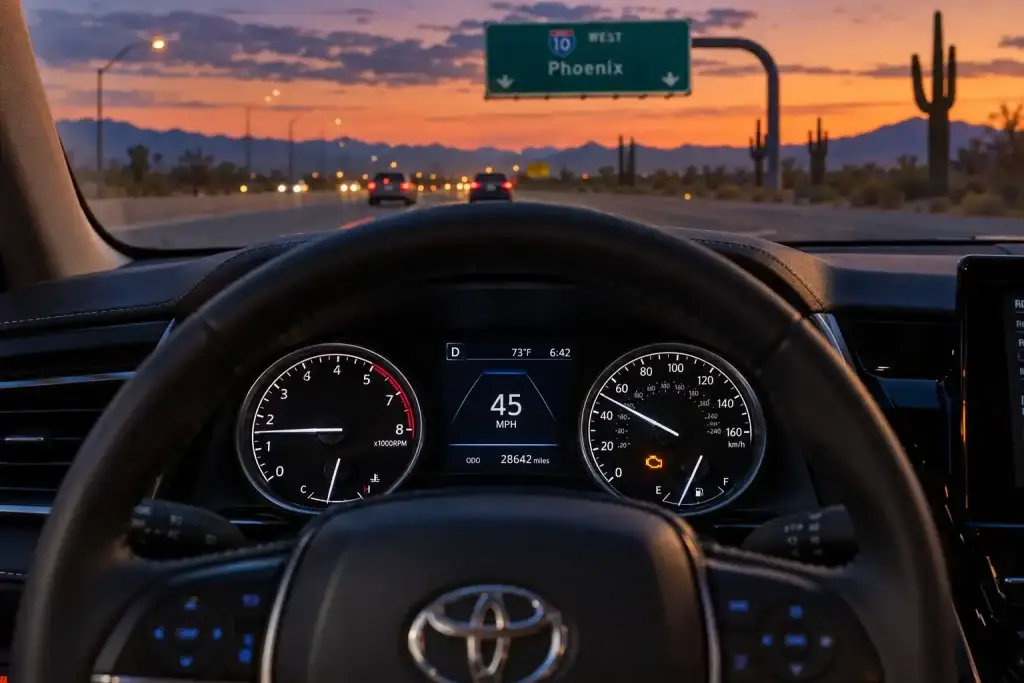
A light just popped up on your dashboard and you want to know one thing fast. What does this light mean, and can you keep driving?
Here is the short answer. Look at the color first. Red means stop soon and check it. Yellow or amber means get it checked soon. Green or blue only means a feature is on.
The most common light by far is the check engine light. It is amber and shaped like an engine. If it is steady, your car found a problem, but you can usually drive to a shop. If it is blinking, slow down and get off the road, because the engine is misfiring and can damage parts quickly.
This guide covers both. You will learn what each common light means, what causes the check engine light, and exactly what to do next. We also cover a few lights you will only see on a Toyota, like MAINT REQD and the hybrid READY light.
Quick tip: Every warning light turns on for a second or two when you start the car. That is a bulb check. Only worry about a light that stays on after the engine is running.
What Do the Colors of Dashboard Lights Mean?
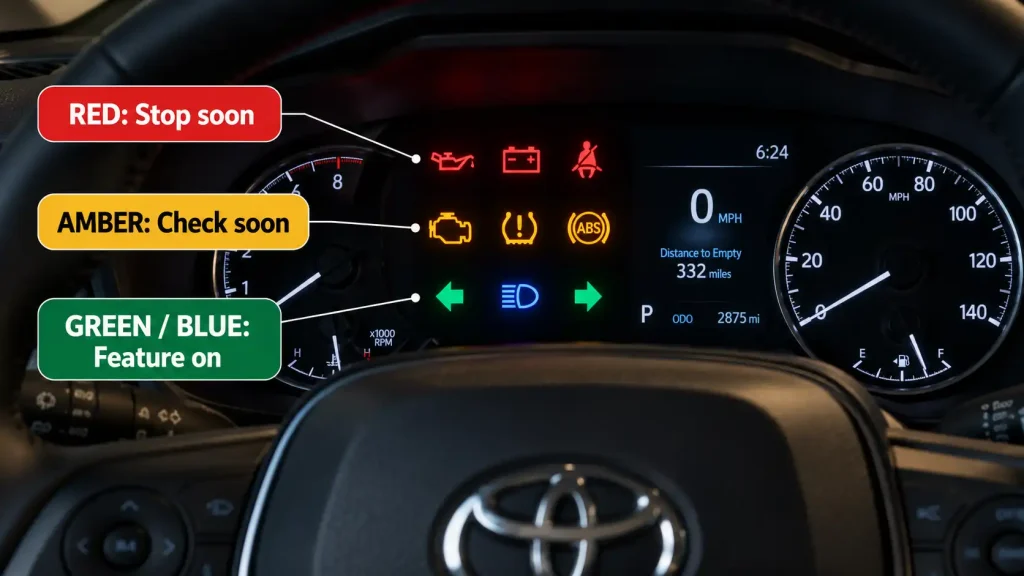
Car makers use a simple color code, a bit like a traffic light. Learn it once and you can judge almost any symbol in a few seconds, even one you have never seen before.
| Color | What it means | What to do |
|---|---|---|
| Red | A serious problem or a safety issue | Pull over when it is safe and turn the engine off. Check before you drive on. |
| Yellow or amber | Something needs attention soon | Keep driving with care and book a check within a few days. |
| Green or blue | A feature is switched on | Nothing. It is just telling you a system is working. |
Blinking changes everything. A light that flashes is more urgent than the same light glowing steady. A blinking amber check engine light should be treated like a red light.
There is also a difference between a warning light and an indicator light. A warning light tells you something is wrong. An indicator light simply tells you something is on, like your high beams or cruise control.
Symbols can vary a little between brands and years. If you see one that does not match anything here, your owner’s manual has a full list for your exact model.
What Does the Check Engine Light Mean?
The check engine light means your car’s computer has found a problem with the engine, the fuel system or the emissions system. It looks like the outline of an engine. On some cars it shows the words CHECK ENGINE or SERVICE ENGINE SOON instead.
Every car and light truck sold in the US since the 1996 model year has an on-board diagnostics system, called OBD-II. This computer watches dozens of sensors while you drive. When a reading falls outside its normal range, it saves a trouble code and turns on the light. You can read more on the Nevada DMV guide to OBD testing.
The light does not tell you what is wrong. It only tells you that something is wrong. The trouble code is the real clue, and you need a scan tool to read it.
What Causes the Engine Light to Come On?
The causes range from a 30-second fix to a serious repair. These are the ones mechanics see most often:
- Loose, cracked or missing gas cap. The fuel system is sealed. A loose cap lets vapor escape and the computer flags it as a leak.
- Bad oxygen sensor. It measures unburned oxygen in the exhaust. When it fails, the engine can burn more fuel than it should.
- Worn spark plugs or a failing ignition coil. These cause misfires, rough idling and weak acceleration.
- Mass airflow sensor problems. A dirty or failed sensor confuses the computer about how much air is coming in.
- Evaporative (EVAP) system leak. A cracked hose or bad valve in the fuel vapor system sets a code, much like a loose gas cap.
- Catalytic converter trouble. This often follows an older problem, like misfires that were ignored for too long.
- Vacuum leaks. A split hose lets in extra air and throws off the fuel mix.
- Thermostat or coolant temperature sensor faults. The engine may run too cold, which hurts fuel economy.
A steady light with no change in how the car drives is often one of the smaller items above. But you will not know until you read the code.
Check Engine Light Is Blinking: What Does That Mean?
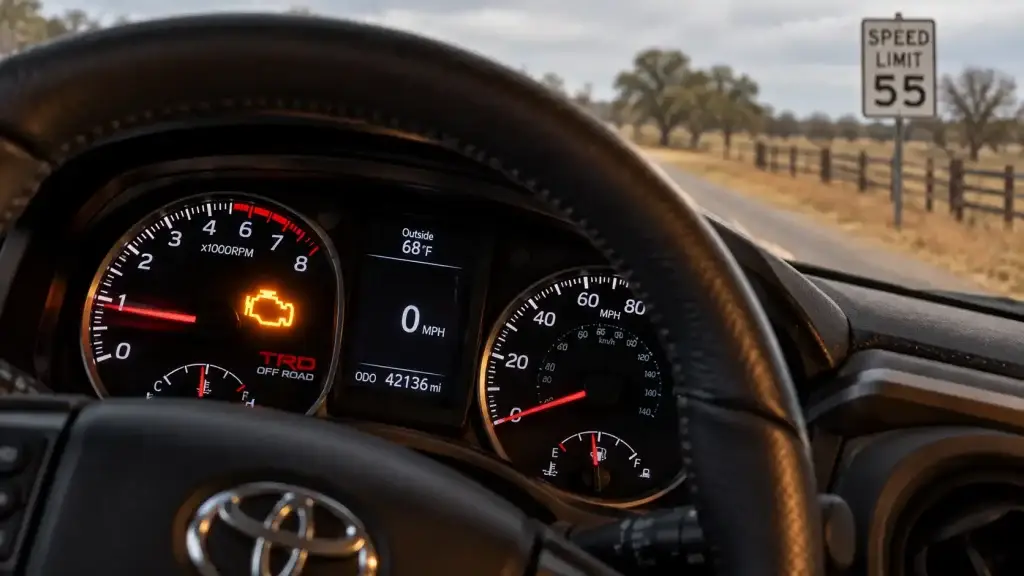
A blinking check engine light almost always means a severe engine misfire. One or more cylinders are not burning fuel properly. That raw fuel goes into the exhaust and can overheat the catalytic converter, which is one of the most expensive parts to replace.
If the light starts flashing while you drive:
- Ease off the gas and avoid hard acceleration.
- Turn off the A/C and anything else that adds load.
- Pull over when it is safe and turn the engine off.
- Have the car towed or drive only a very short distance to a shop at low speed.
Some cars flash the light only under load and stop when you slow down. That is still a warning. The misfire is real, even if the light settles back to steady.
What to Do When the Check Engine Light Comes On
If the light is steady and the car feels normal, you do not need to panic. Work through these steps:
- Check the other gauges. Look at the temperature gauge and any red lights. If the engine is overheating or the oil light is on, stop driving.
- Notice how the car drives. Shaking, stalling, loss of power, strange smells or smoke mean you should stop and get help.
- Tighten the gas cap. Open it and close it until it clicks. If it looks cracked or the seal is torn, replace it.
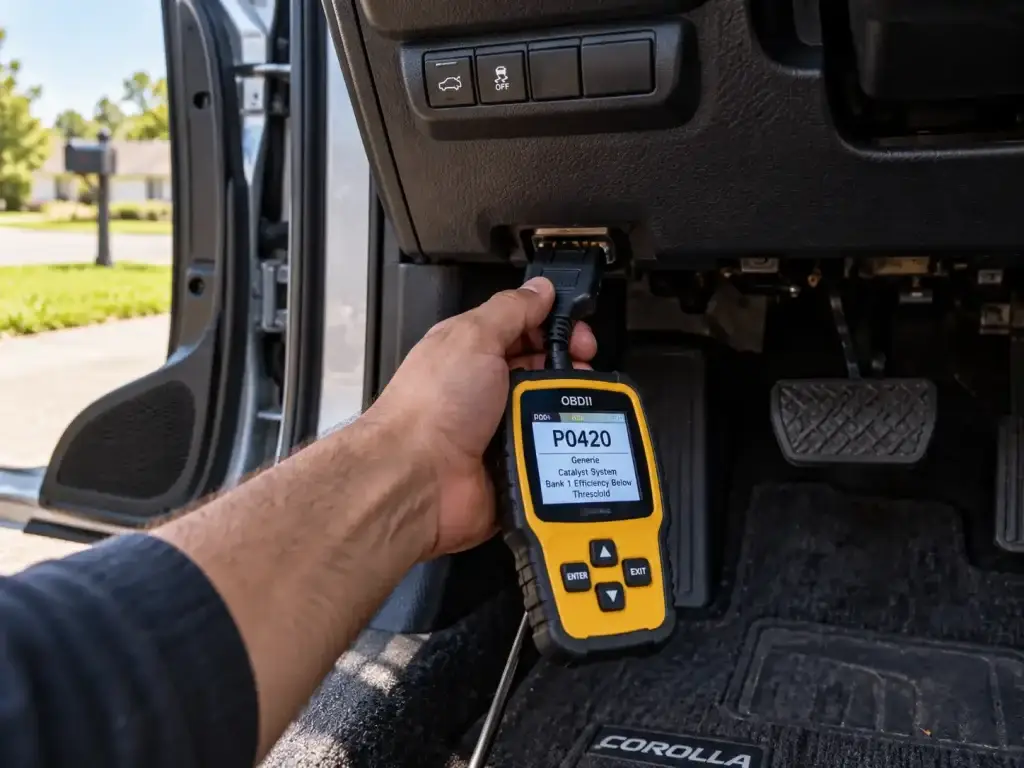
- Get the code read. Plug an OBD-II scanner into the port under the dashboard, near your left knee. Basic scanners are cheap, and many auto parts stores will read the code for free.
- Look up the code. Codes start with a letter and four numbers, like P0420. The P means powertrain. The code points you toward the system that failed.
- Book a repair. Even if the car feels fine, a small fault can grow. A failing sensor can lower your gas mileage for months without you noticing.
Keep a note of the code and when the light came on. It helps your mechanic and saves diagnosis time. Our Owner Guides cover more basic maintenance you can do at home.
If the Check Engine Light Goes Off, What Does That Mean?
Sometimes the light turns off by itself. This usually means the computer ran its self-tests and the problem did not come back. A tightened gas cap often clears this way after a few days of normal driving.
But the light going off does not erase the history. The trouble code usually stays saved in the computer for a while. If the light keeps coming and going, the fault is likely intermittent, such as a sensor that works only some of the time. Get it checked before it becomes constant.
Can You Drive With the Check Engine Light On?
- Steady light, car drives normally: Usually yes, for a short time. Get the code read within a few days.
- Steady light, car drives badly: Drive gently and only to a shop.
- Blinking light: No. Stop and arrange help.
- Light plus a red warning: No. The red light comes first.
One more thing. In states that use OBD emissions testing, a car with the check engine light on will usually fail the test. Clearing the code with a scanner right before the test rarely works either. The computer needs some normal driving to finish its self-checks, and an unfinished check can also lead to a failed test.
Red Warning Lights: Stop Soon
A red light is your car telling you to stop and look. Ignoring one can lead to engine damage or an unsafe car.

Oil Pressure Light
Symbol: an old oil can with a drip.
This means the engine has lost oil pressure. Oil keeps metal parts from grinding on each other, so this is one of the most serious lights on the dash. Pull over and turn off the engine right away. Once it has cooled a little, check the dipstick. If the oil is low, top it up. If the light stays on with full oil, do not drive. The oil pump or a sensor may have failed.
Engine Temperature Light
Symbol: a thermometer sitting in wavy lines of liquid.
Red means the engine is overheating. Turn off the A/C and turn the heater to full hot. It sounds odd, but it pulls heat away from the engine. Pull over and switch off. Never open the radiator cap on a hot engine, because the coolant is under pressure and can burn you. Some cars show this symbol in blue when the engine is still cold. That is normal and goes away as it warms up.
Battery or Charging Light
Symbol: a small battery with + and – marks.
The charging system is not working. The problem could be the alternator, a loose belt, a bad cable or the battery. Your car is now running on battery power alone and will soon stall. Turn off extra electrical loads like the radio and heated seats, and drive straight to a shop if it is close.
Brake System Light
Symbol: an exclamation mark in a circle, or the word BRAKE.
First, check that the parking brake is fully released. If it is, the light may mean low brake fluid or a problem in the brake system. Test the brakes gently at low speed. If the pedal feels soft or sinks, stop driving and call for a tow.
Airbag Light
Symbol: a seated person with a large circle in front.
The car will drive normally, but the airbags may not work in a crash. Get it checked soon, especially if you carry children or passengers.
Seat Belt and Door Lights
These are simple. Someone is unbuckled, or a door, hood or trunk is not fully closed. Buckle up or close it firmly and the light goes out.
Yellow and Amber Warning Lights: Check Soon
Amber lights are early warnings. The car is usually safe to drive, but the problem will not fix itself.
Tire Pressure Light (TPMS)
Symbol: an exclamation mark inside a horseshoe shape, like a tire seen from the side.
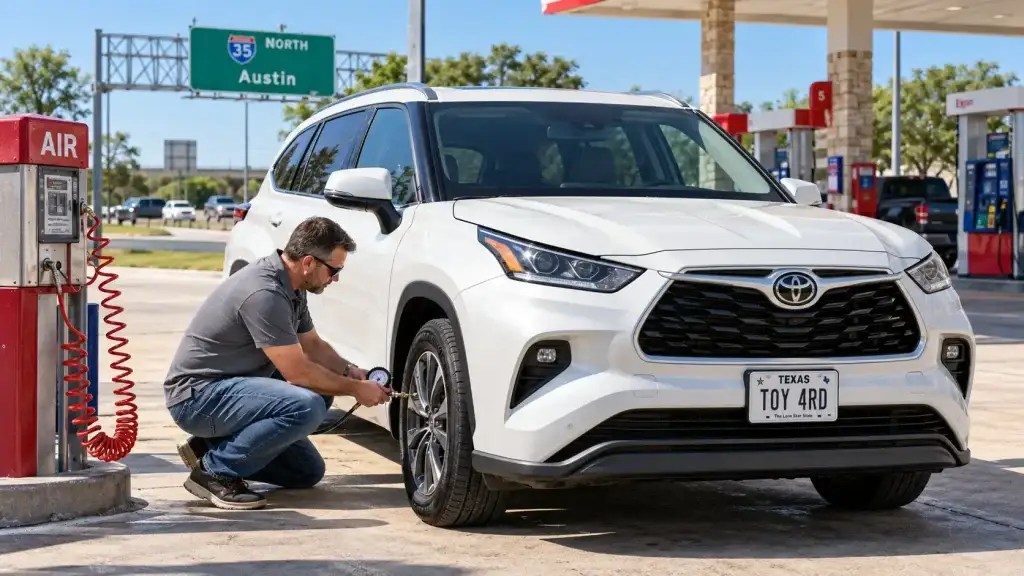
One or more tires are low. Check all four with a gauge and fill them to the pressure on the sticker inside the driver’s door jamb, not the number on the tire itself. Cold mornings often trigger this light because air shrinks in the cold. If the light flashes for about a minute and then stays on, the problem is usually the sensor system rather than the air pressure.
ABS Light
Symbol: the letters ABS in a circle.
Your normal brakes still work, but the anti-lock feature is off. In a hard stop on a wet or icy road, the wheels may lock up. Leave more space to the car ahead and get it checked soon. If the ABS light and the red brake light come on together, treat it as a red light.
Traction and Stability Control Light
Symbol: a car with two wavy lines behind it.
If it flashes while you drive, that is good news. The system is working to stop a wheel from slipping on a wet or icy road. Ease off the gas. If it stays steady or shows the word OFF, the system has been switched off or has a fault. Check whether you pressed the button by mistake.
Low Fuel Light
Symbol: a gas pump.
Time to fill up. The small arrow next to the fuel gauge shows which side your fuel door is on. Running very low often is hard on the fuel pump, which uses fuel to stay cool.
Power Steering Light
Symbol: a steering wheel, often with an exclamation mark.
Steering will feel heavy. You can still steer, but it takes more effort, so drive slowly to a shop.
Transmission Temperature Light
Symbol: a gear with a thermometer inside.
The transmission is too hot. This happens most with heavy towing, hills or stop-and-go heat. Pull over and let it idle in park to cool down. If it keeps coming back, have the fluid checked.
Washer Fluid Light
Symbol: a windshield with a spray of water.
The washer fluid is low. Top it up with washer fluid, not plain water, which can freeze in winter.
Why Are Several Lights On at Once?
When many lights come on together, the cause is often electrical. A weak battery or a failing alternator can confuse several systems at the same time, so the ABS, traction control and check engine lights may all appear. Get the battery and charging system tested first.
Buying used? Turn the key to ON before starting the engine and make sure every warning light comes on for a moment. A light that never turns on may have been disabled to hide a problem. We use this check in our 2018 Toyota Highlander buying guide, and it works on any used car.
Green and Blue Lights: Nothing Is Wrong
These are indicator lights. They confirm that something you switched on is working.
- Turn signal arrows (green): Blinking normally means all is fine. If one blinks much faster than usual, a bulb is out on that side.
- Headlights (green): Your low beams or parking lights are on.
- High beams (blue): Switch them off when another car is coming toward you.
- Cruise control (green): Cruise is set and holding your speed.
- Fog lights (green): Your front fog lamps are on.
- Cold engine (blue): The engine has not warmed up yet. Drive gently for the first few minutes.
Toyota Lights You Will Not See on Every Car
Toyota uses a few lights and messages that confuse new owners. Here is what they mean.
MAINT REQD
This is a reminder, not a fault. It tells you scheduled maintenance is due, most often an oil change. The interval depends on your model and engine, so check the maintenance schedule in your owner’s manual. After the service, the light needs to be reset. Most shops do this for you, and the manual shows the button steps if you do it yourself.
Do not confuse it with the check engine light. MAINT REQD is about time and mileage. The check engine light is about a detected problem.
Master Warning Light
Symbol: an exclamation mark inside a triangle.
This light comes on with a message on the small screen between your gauges. The triangle alone tells you very little. Read the message that appears with it, because that tells you the actual problem. It can range from a door left open to a system fault.
READY (Hybrids)
On a Toyota hybrid, the green READY light means the car is on and ready to drive, even if the engine is silent. Hybrids can start and pull away on electric power alone. If READY is not lit, the car will not move when you press the gas. You can learn more about how this works in our Prius vs Prius c comparison.
Check Hybrid System
This message means the hybrid system found a fault. The car may limit power to protect itself. Drive gently to a Toyota dealer or a shop that works on hybrids and avoid long trips until it is checked.
Toyota Safety Sense Lights
Amber lights for features like the pre-collision system or lane assist often mean the system is off or cannot see well. Dirt, snow, ice or heavy rain on the windshield camera or front grille sensor are common causes. Clean them and the light often clears on its own. Our Toyota Explained section covers what each Safety Sense feature does.
Car Symbols and What They Mean: Quick Reference
Save this table for the next time you wonder what this light means.
| Light | Color | Can I keep driving? |
|---|---|---|
| Check engine (steady) | Amber | Yes, but get the code read within a few days |
| Check engine (blinking) | Amber, flashing | No. Pull over and get help |
| Oil pressure | Red | No. Stop and turn off the engine |
| Engine temperature | Red | No. Stop and let it cool |
| Battery or charging | Red | Only a short distance to a shop |
| Brake system | Red | Only if the parking brake was the cause |
| Airbag | Red | Yes, but fix it soon |
| Tire pressure | Amber | Yes, slowly, to the nearest air pump |
| ABS | Amber | Yes, with extra stopping distance |
| Traction control (flashing) | Amber | Yes. It is working, so ease off the gas |
| Transmission temperature | Amber | Stop and let it cool |
| MAINT REQD (Toyota) | Amber text | Yes. Book your scheduled service |
| Master warning (Toyota) | Amber or red | Read the message on the display first |
| READY (Toyota hybrid) | Green | Yes. The car is on |
| High beams | Blue | Yes |
Frequently Asked Questions
What does it mean when the check engine light comes on?
It means your car’s computer found a problem with the engine, fuel or emissions system and saved a trouble code. The cause can be as small as a loose gas cap or as serious as a misfire. A scan tool reads the code and points to the fault.
Is a blinking check engine light an emergency?
Yes. A blinking light usually means a severe misfire that can damage the catalytic converter. Slow down, pull over when it is safe and arrange help rather than driving on.
Can a loose gas cap really turn on the check engine light?
Yes. It is one of the most common causes. Tighten the cap until it clicks. The light should go off on its own after a few days of normal driving if that was the problem.
Why did my check engine light turn off by itself?
The computer re-tested the system and the fault did not come back. The code may still be stored, though. If the light keeps returning, have it checked.
Will disconnecting the battery reset the check engine light?
It can clear the light on some cars, but it does not fix anything. If the fault is still there, the light comes back. It can also reset radio presets and make the car fail an emissions test until the self-checks finish again.
What is the difference between red and yellow dashboard lights?
Red means a serious or safety problem, so stop soon. Yellow or amber means something needs attention, but you can usually keep driving with care.
Is the Toyota MAINT REQD light a problem?
No. It is a service reminder, usually for an oil change. It is not the same as the check engine light.
The Bottom Line
Next time you ask yourself what this light means, start with the color. Red means stop soon. Amber means check it soon. Green or blue means a feature is on. For the check engine light, steady means book a scan, and blinking means pull over.
A cheap OBD-II scanner in the glovebox is one of the best tools any driver can own. It turns a scary light into a code you can look up in minutes.