
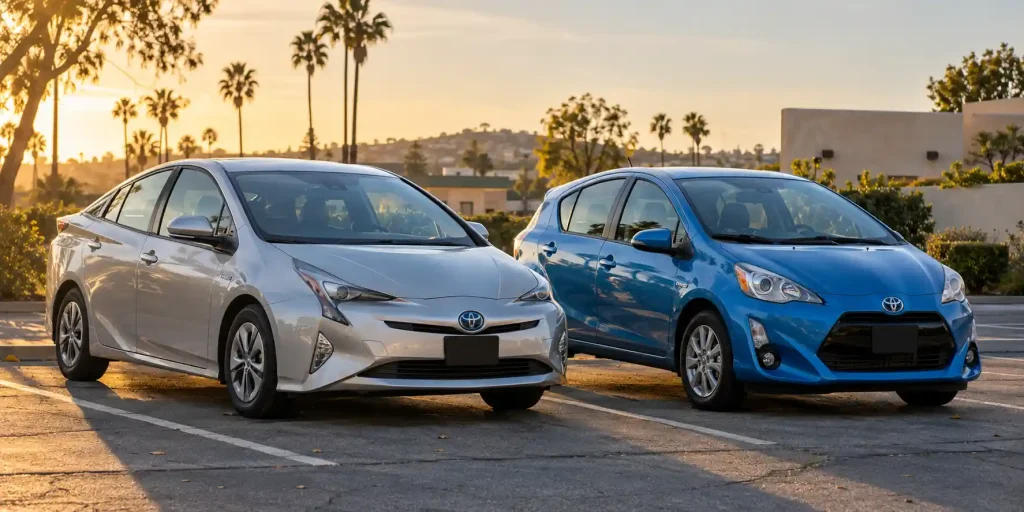
The Toyota Prius is a compact hybrid liftback with a bigger engine, more power and more cargo room. The Prius c is a smaller subcompact hybrid hatchback with a 1.5 liter engine and 99 horsepower. Toyota sold the Prius c in the United States from the 2012 to the 2019 model year.
In short, the c is easier to park and was cheaper when new. The regular Prius is roomier, quicker and more comfortable on the highway. Which one gets better gas mileage depends on the model year you compare.
Here is the quick version before we get into the details:
- Size: The Prius c is about 16 inches shorter than a 2016 to 2022 Prius.
- Power: 99 hp for the c, against 121 to 134 hp for older Prius models and about 196 hp for the newest one.
- Cargo: 17.1 cubic feet in the c, against 24.6 to 27.4 cubic feet in a 2016 to 2022 Prius.
- MPG: The c wins for 2012 to 2016. The regular Prius wins from 2016 onward.
- Availability: The Prius c is used only. You can still buy a new Prius.
Toyota Prius vs Prius c at a Glance
The fairest way to compare them is the same model year. This table uses the 2018 Prius and the 2018 Prius c, since both were on sale that year.
| Spec | 2018 Toyota Prius | 2018 Toyota Prius c |
|---|---|---|
| Vehicle class | Compact liftback | Subcompact hatchback |
| Gas engine | 1.8 liter four cylinder | 1.5 liter four cylinder |
| Total hybrid power | 121 hp | 99 hp |
| Length | 178.7 in | 162.4 in |
| Wheelbase | 106.3 in | 100.4 in |
| Cargo space, seats up | 24.6 to 27.4 cu ft | 17.1 cu ft |
| Passenger volume | 93.1 cu ft | 87.4 cu ft |
| Rear legroom | 33.4 in | 35.0 in |
| Fuel tank | 11.3 gal | 9.5 gal |
| Rear brakes | Disc | Drum |
| Rear suspension | Double wishbone | Torsion beam |
| EPA city / hwy / combined | 54 / 50 / 52 mpg | 48 / 43 / 46 mpg |
| Safety package | Toyota Safety Sense P | Toyota Safety Sense C |
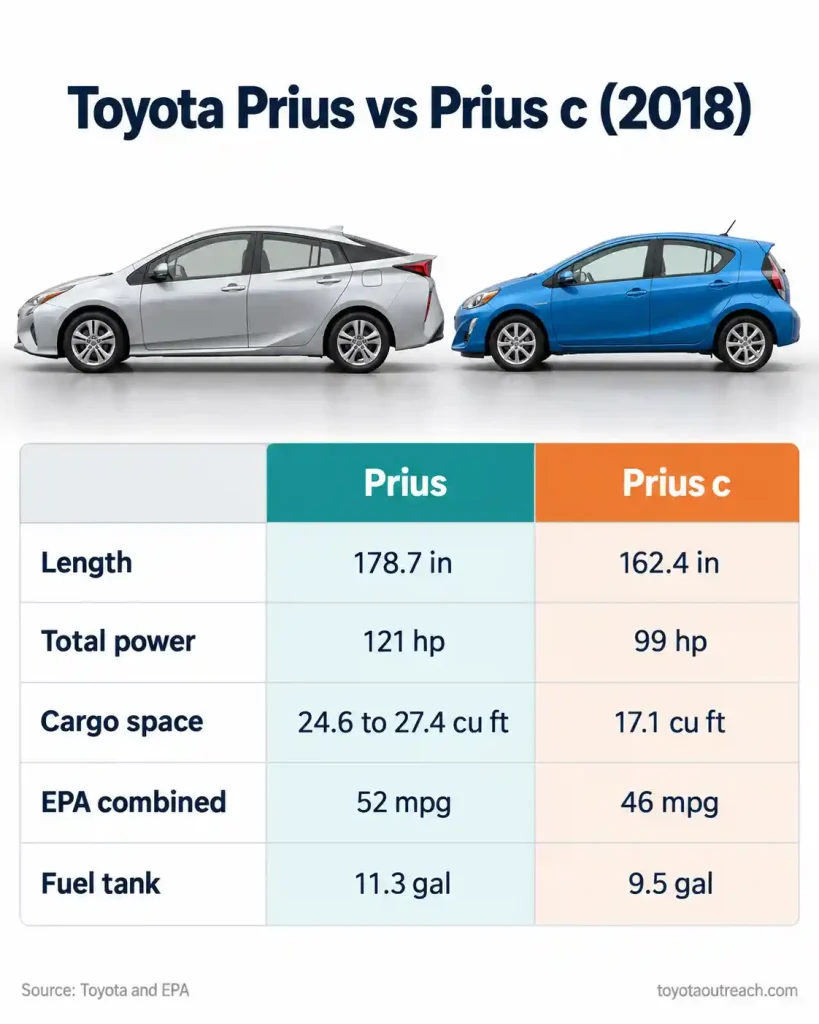
The big story is size. The Prius c gives up length, cargo space and power to be a lighter, easier city car. It is not a lower trim of the Prius. It is a separate, smaller model with its own body and powertrain.
What Does the c in Prius c Stand For?
The c stands for city. Toyota built it for short trips, tight streets and small parking spots. It rides on a smaller platform shared with the Yaris family, which explains its short body and lighter weight.
The Prius c launched in the US in early 2012. It was the cheapest way into a Toyota hybrid for most of its life. Toyota confirms 2019 was the final US model year for the Prius c.
Model Year Timeline: Which Prius Matches Which Prius c?
This is where most buyers get confused. The regular Prius changed a lot during the years the Prius c was sold. A 2013 Prius and a 2018 Prius are very different cars.
Use this timeline to match the car in a listing to the right specs.
| Model years | Toyota Prius | Toyota Prius c |
|---|---|---|
| 2010 to 2015 | Third generation, 1.8 liter, 134 hp, EPA 50 mpg combined at launch (now listed at 48) | Prius c arrives for 2012, 1.5 liter, 99 hp, 50 mpg combined |
| 2016 to 2022 | Fourth generation, 1.8 liter, 121 hp, 52 mpg combined (56 in the Eco trim), AWD-e option from 2019 | 2012 to 2016 cars rated 50 combined. 2017 to 2019 cars rated 46 combined. Facelift for 2018 |
| 2023 onward | Fifth generation, 2.0 liter, about 194 to 196 hp, sleeker body | No longer sold in the US after 2019 |
Two things stand out. First, the Prius c never got a full redesign. Second, the regular Prius got more efficient in 2016 while the Prius c rating dropped for 2017. That flipped the MPG winner.
Size and Parking

The Prius c is the clear winner if you live with tight parking. In the 2018 comparison, it is 16.3 inches shorter than the regular Prius. Its wheelbase is about 6 inches shorter too.
A short car also turns tighter. A 2019 Prius c has a curb to curb turning circle of about 31 feet. That makes U turns and parallel parking easier on narrow city streets.
The Prius c is also roughly 500 pounds lighter than a regular Prius. Less weight helps around town, but it also means the car can feel less settled on the highway, especially in strong wind.
Interior Space and Cargo
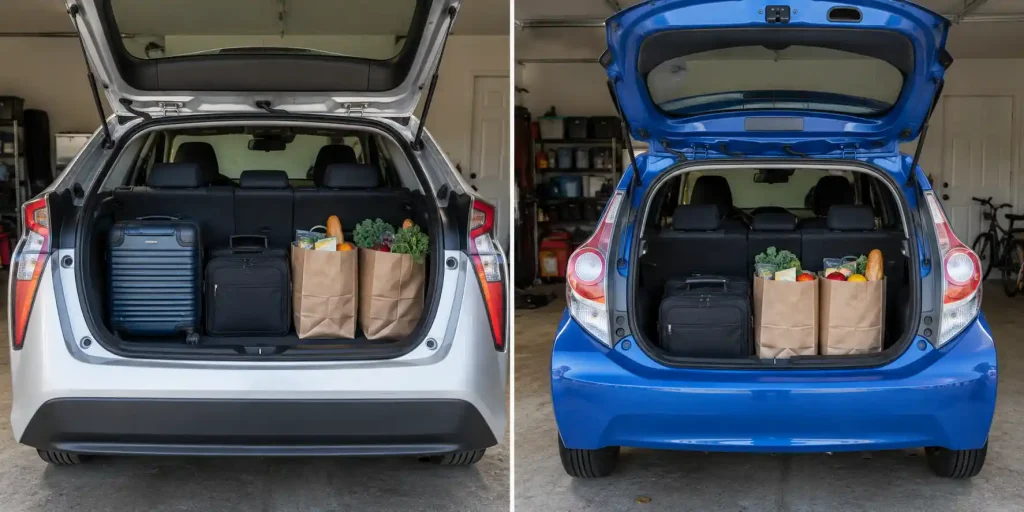
Both cars seat five, but the regular Prius has more room overall. It offers about 6 more cubic feet of passenger space and a much bigger cargo area.
Here is what that means in daily use:
- Cargo: The Prius holds 24.6 to 27.4 cubic feet behind the rear seat, depending on trim. The Prius c holds 17.1 cubic feet. With the rear seat up, that is 7 to 10 extra cubic feet in the regular Prius.
- Rear legroom: The Prius c actually lists slightly more rear legroom, 35.0 inches against 33.4. The regular Prius still has more shoulder room and width.
- Front seats: The regular Prius is wider inside. Taller drivers usually find it easier to get comfortable on long drives.
If you often carry a stroller, golf clubs or luggage for four people, the regular Prius is the safer pick. Bring your biggest everyday item to the test drive and see if it fits.
Engine, Power and Driving Feel
Both cars use Toyota’s full hybrid system. A gas engine and electric motors work together through an electronically controlled CVT. Neither car needs to be plugged in. If you want the basics, here is how Toyota hybrid systems work.
The difference is in size and output:
- Prius c: 1.5 liter engine, 99 hp total, 82 lb-ft of engine torque.
- 2010 to 2015 Prius: 1.8 liter engine, 134 hp total.
- 2016 to 2022 Prius: 1.8 liter engine, 121 hp total.
- 2023 and newer Prius: 2.0 liter engine, about 194 to 196 hp total.
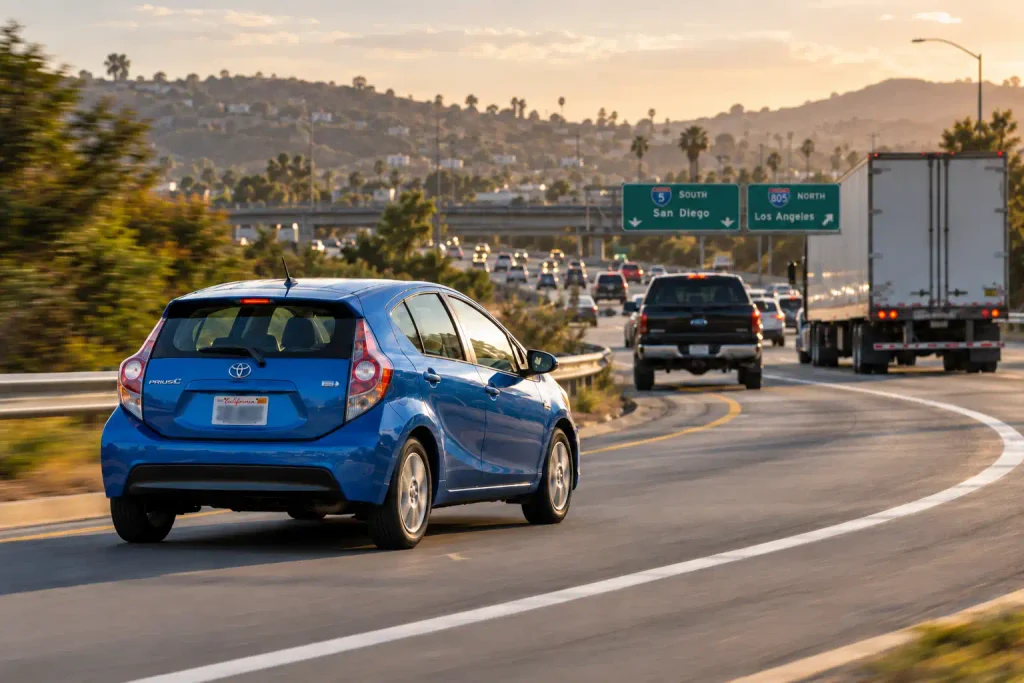
In town, the Prius c feels fine. It is light, and the electric motor helps from a stop. On the highway, it is a different story. Merging and passing take more planning, and the engine works harder on long climbs.
Hardware Differences Most Buyers Miss
Some of the gap comes from parts you cannot see on a spec sheet:
- Rear brakes: The Prius c uses rear drum brakes. The 2016 and newer Prius uses rear disc brakes.
- Rear suspension: The Prius c uses a simple torsion beam. The 2016 to 2022 Prius uses a double wishbone setup, which helps ride comfort on rough roads.
- Wheels and tires: The Prius c rides on 15 inch wheels with 175/65R15 tires. That keeps tire costs low.
- Fuel tank: 9.5 gallons in the c against 11.3 gallons in the 2016 to 2022 Prius. You will stop for gas a little more often in the c.
None of this makes the Prius c a bad car. It simply shows it was built to a lower price, for shorter trips.
Which Gets Better Gas Mileage?
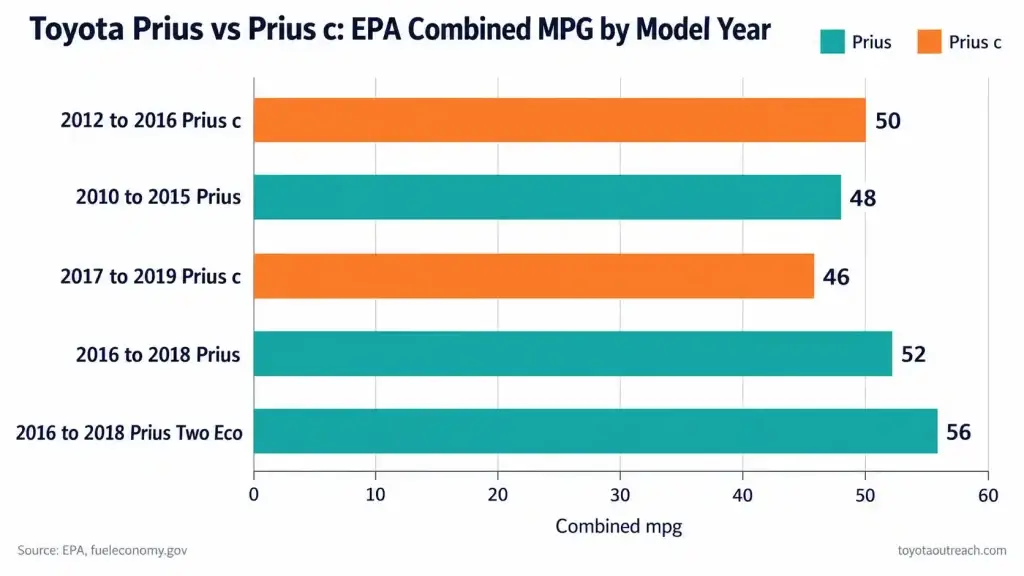
The answer changes with the model year. Many shoppers assume the smaller car always wins. That is only true for the early years.
| US model | City mpg | Highway mpg | Combined mpg |
|---|---|---|---|
| 2012 to 2016 Prius c | 53 | 46 | 50 |
| 2010 to 2015 Prius (current EPA listing) | 49 | 46 | 48 |
| 2017 to 2019 Prius c | 48 | 43 | 46 |
| 2016 to 2018 Prius (non Eco trims) | 54 | 50 | 52 |
| 2016 to 2018 Prius Two Eco | 58 | 53 | 56 |
These are EPA estimates. Your real mileage depends on speed, weather, tires and how you drive. You can check any two exact cars with the EPA and DOE side by side tool.
One more note on older cars. When the 2010 to 2015 Prius was new, Toyota advertised 51 city and 48 highway. The EPA now lists the revised 49 and 46 numbers. That is why you may see both figures in old ads and listings.
What the MPG Gap Costs You
Let’s put real dollars on it. Say you drive 15,000 miles a year and gas costs $3.50 a gallon.
- 2018 Prius at 52 mpg: about 288 gallons, or about $1,010 a year.
- 2018 Prius c at 46 mpg: about 326 gallons, or about $1,141 a year.
That is a gap of roughly $130 a year. Over five years, it adds up to about $650. This is an example based on EPA ratings, not a promise about your fuel bill. Still, it shows that purchase price and condition usually matter more than a few MPG.
Safety Features by Year
The safety tech is not the same in both cars.
The 2016 and newer Prius offered Toyota Safety Sense P. On 2017 and later models it is standard. It adds pedestrian detection, lane departure alert with steering assist, automatic high beams and full speed radar cruise control.
The 2017 to 2019 Prius c came with Toyota Safety Sense C. It includes a pre collision system, lane departure alert and automatic high beams. It does not include radar cruise control. Earlier Prius c models have none of these driver aids.
Want to know what each system does in plain words? See our guides to Toyota Safety Sense and other Toyota tech. For crash test scores, look up the exact model year on the IIHS and NHTSA websites.
Ownership Costs and Long Term Reliability
Both cars share Toyota’s reputation for long life. Many owners drive them well past 150,000 miles with basic care. Toyotas that get regular service can stay on the road for a very long time, much like one owner who kept the same Camry for 20 years.
Here is where costs can differ:
- Purchase price: The 2019 Prius c started at $21,530 when new. That made it the budget choice. Today, used prices depend far more on mileage and condition than on the badge.
- Tires: The c uses small 15 inch tires, which are usually cheaper to replace.
- Brakes: Hybrids use regenerative braking, so pads and shoes tend to last a long time on both cars.
- Insurance: Rates depend on your location, record and the exact car. Get quotes for both before you decide.
The Hybrid Battery Question
The high voltage battery is the biggest cost worry on any used hybrid. Every Prius c and every Prius from these years is now old enough that the original hybrid warranty has likely run out. Toyota’s longer 10 year or 150,000 mile hybrid battery warranty applies to 2020 and newer vehicles, so it does not cover any Prius c.
Ask the seller if the hybrid battery is original or replaced. If it was replaced, ask for the invoice and any warranty paperwork. Then have a hybrid savvy shop test the battery before you buy.
Used Buying Checklist for a Prius or Prius c

Since every Prius c is now a used car, the condition of the exact car matters most. Run through these checks before you pay a deposit. For more pre purchase tips, browse our used Toyota owner guides.
- Match the VIN to the listing. Confirm the model year, trim and whether it is a Prius, Prius c, Prius v or plug in model.
- Check recalls. Enter the VIN in the NHTSA recall lookup and ask a Toyota dealer about open service campaigns.
- Read the service records. Look for regular oil changes and any hybrid system repairs.
- Test the hybrid battery. Ask a hybrid savvy shop for a battery health check and get the results in writing.
- Look at the battery cooling intake. Both cars pull cabin air to cool the hybrid battery. A vent clogged with dust or pet hair can make the battery run hot.
- Ask about oil use on a 2010 to 2015 Prius. Some third generation cars with the 1.8 liter engine were known to burn oil. Ask how often the owner tops it up.
- Check the 12 volt battery. Hybrids also have a small 12 volt battery. A weak one can cause odd warning lights and no start problems.
- Drive it on your real route. Include a highway on ramp and a hill. This matters more for the Prius c, since power is the weak spot.
A cheaper car that needs a battery soon is not a bargain. Add any repair the inspection finds to the asking price before you compare.
Prius vs Prius c: Which One Should You Buy?
Assuming both cars are in similar condition and fairly priced, use this table as a starting point.
| Your situation | Better pick |
|---|---|
| City driving and tight parking | Prius c |
| Lowest buy in price and cheap tires | Prius c |
| Best MPG in a 2012 to 2015 car | Prius c |
| Best MPG in a 2016 or newer car | Prius |
| Regular highway commuting | Prius |
| Family trips with passengers and luggage | Prius |
| Radar cruise control and more driver aids | Prius |
| Taller drivers who want more room | Prius |
Choose the Prius c if you mostly drive alone in town, park on busy streets and want a simple, low cost hybrid.
Choose the regular Prius if you spend real time on the highway, carry people or cargo, or want newer safety tech.
What About the Prius v?
The Prius v is the third member of the family. The v stands for versatility. It is a longer, wagon style Prius with about 34.3 cubic feet of cargo space behind the rear seat. It was sold in the US from the 2012 to the 2017 model year.
So the family lines up by size: Prius c is the small one, Prius is the middle one, and Prius v is the big one. Do not confuse the Prius v with the Prius Five, which was a trim level of the regular Prius.
Frequently Asked Questions
Is the Prius c smaller than the Prius?
Yes. The Prius c is a subcompact car, while the regular Prius is a compact. A 2018 Prius c is 162.4 inches long, which is 16.3 inches shorter than a 2018 Prius.
Is the Prius c more fuel efficient than the regular Prius?
Only for some years. The 2012 to 2016 Prius c is rated at 50 mpg combined, which beats the 2010 to 2015 Prius. From 2016 on, the regular Prius is rated higher, at 52 to 56 mpg combined against 46 for the 2017 to 2019 Prius c.
Why did Toyota stop selling the Prius c?
Toyota ended US sales of the Prius c after the 2019 model year. Toyota did not publish a single detailed reason. Around the same time, its lineup shifted toward the Corolla Hybrid and hybrid SUVs.
Is the Prius c a good car to buy used?
It can be a smart buy for city drivers on a budget. It is simple, light and cheap to fuel. Just check the hybrid battery, service records and recall history before you buy, since even the newest one is several years old.
Does the Prius c need to be plugged in?
No. The Prius c is a regular hybrid. Its battery charges from the gas engine and from braking. The same is true of the standard Prius. Only the Prius Plug-in and Prius Prime need to be plugged in.
Is the Prius c good on the highway?
It can handle highway driving, but it is not its strong point. With 99 hp, merging and passing take more planning, and the cabin is louder at speed than in the regular Prius. If you drive the highway every day, the regular Prius is the more relaxed choice.
Final Word
The difference between the Toyota Prius and Prius c comes down to size, power and how you drive. The Prius c is a small, simple city hybrid that was built to be affordable. The regular Prius is the roomier, stronger all rounder, and the newer ones beat the c on fuel economy too.
Match the model years, check the hybrid battery, and drive both on your daily route. That will tell you more than any spec sheet.