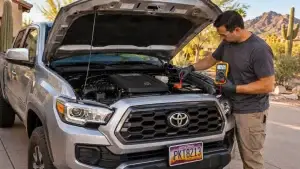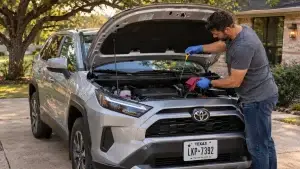
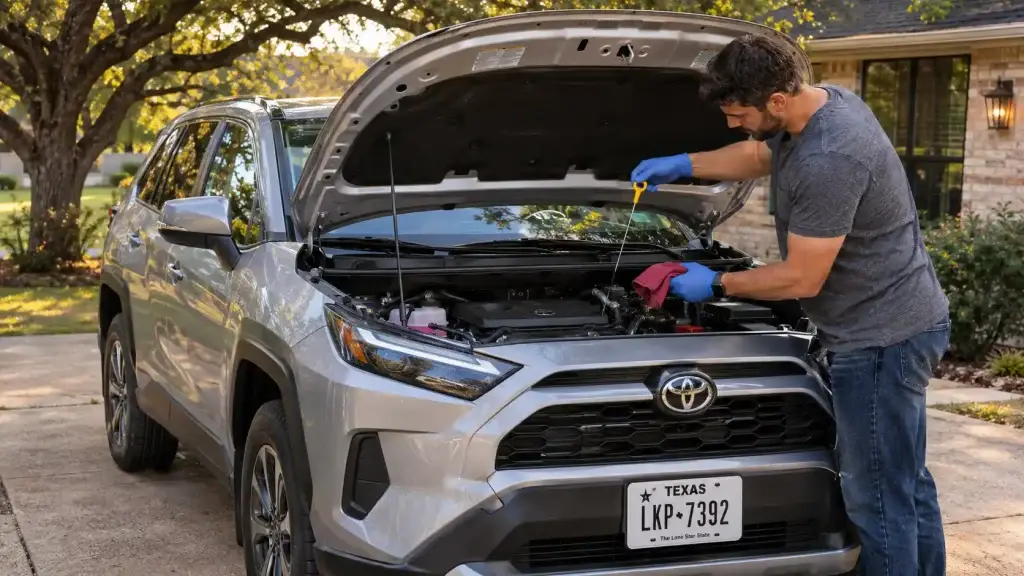
Checking your oil takes about two minutes and costs nothing. Skipping it is one of the easiest ways to wear out an engine early.
This guide shows you how to check oil level in car engines the right way. You will learn how to read the dipstick, what the oil color means, how much to add and which oil your car actually needs. We also cover hybrids and cars that have no dipstick at all.
Park on level ground and turn the engine off. If you just drove, wait at least 5 minutes so the oil drains back into the pan. Pull the dipstick, wipe it clean, push it all the way back in and pull it out again. The oil line should sit between the low and full marks. If it is at or below the low mark, add a little of the oil your owner’s manual lists, then check again.
What You Need Before You Check Your Oil
You do not need tools or any mechanical skill. Grab these few things first:
- A clean, lint-free rag or paper towel
- A flashlight if you are checking at night or in a dark garage
- Gloves if you want to keep your hands clean
- A funnel and a quart of the correct oil, in case you need to top up
- Your owner’s manual, which shows where the dipstick is and which oil to use
How to Check Engine Oil in 7 Steps
These steps work for almost every gas engine, from a Corolla to a Tundra. If your owner’s manual says something different, follow the manual.
Step 1: Park on Level Ground
A slope tilts the oil to one side of the oil pan. That gives you a reading that is too high or too low. A flat driveway or parking spot is all you need.
Step 2: Turn Off the Engine and Wait
Oil needs time to drain from the top of the engine back into the pan. Toyota owner’s manuals say to check with the engine warm, then wait more than 5 minutes after you shut it off.
If the car has sat overnight, the oil has already drained down. You can check it right away unless your manual says otherwise.
Step 3: Open the Hood and Find the Dipstick
Pull the hood release inside the car, then lift the hood and set the prop rod. The oil dipstick usually has a bright yellow or orange loop handle. Many show an oil can symbol or the words ENGINE OIL.
Some older cars also have a transmission dipstick. If you see two, check the labels or the diagram in your manual so you pull the right one.
Step 4: Pull the Dipstick Out and Wipe It Clean
Hold a rag under the tip as you pull it out so oil does not drip on hot engine parts. Wipe the whole end clean. This first pull is not your reading, because oil splashes up the tube while you drive.
Step 5: Push It All the Way Back In
Slide the dipstick back into its tube until the handle seats fully. If it stops short, the reading will be wrong. On some models the dipstick only fits one way, so do not force it.
Step 6: Pull It Out Again and Read the Level
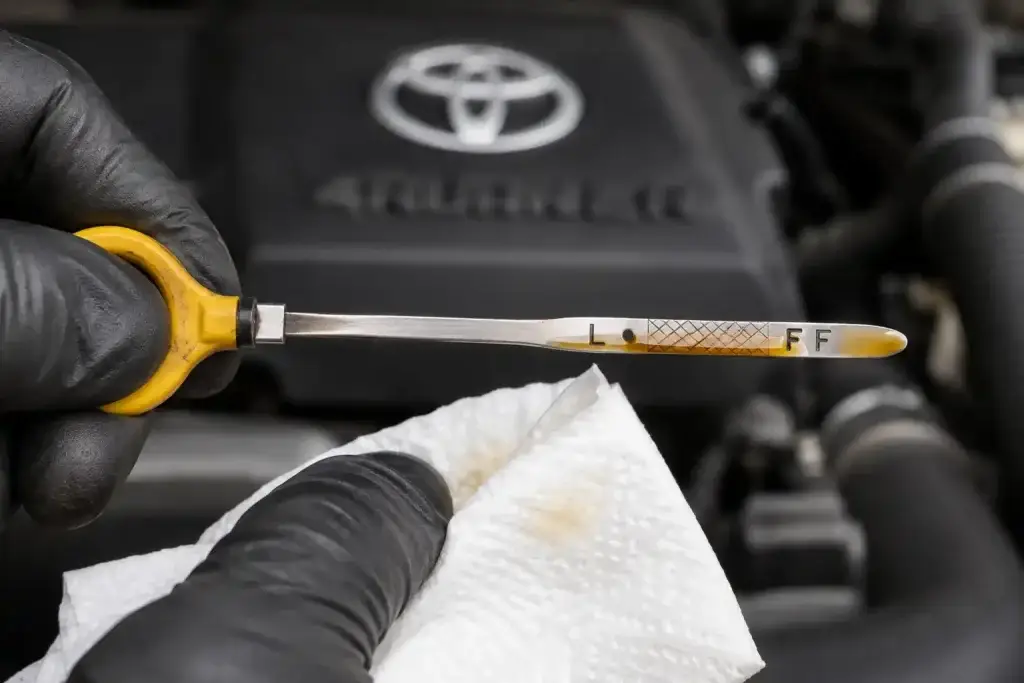
Pull it straight out and hold it level. Look at both sides of the tip. The oil level is where the solid oil film stops. If one side shows a higher smear, trust the lower, cleaner line.
Step 7: Check the Color, Then Put It Back
Look at the oil on the rag before you finish. The color and feel tell you a lot about engine health, which we cover below. Push the dipstick fully back in and close the hood firmly.
How to Read the Oil Level on a Dipstick
Every dipstick has two marks near the tip. They may be two small holes, two notches, the letters L and F, MIN and MAX, or a crosshatched zone. The bottom mark is low. The top mark is full.
| Where the oil line sits | What it means | What to do |
|---|---|---|
| Between the marks, near the top | Full | Nothing, you are good |
| Between the marks, near the bottom | Safe but getting low | Top up soon and recheck in a week |
| At or below the low mark | Low | Add oil before you drive far |
| Above the full mark | Overfilled | Have the extra oil drained |
| No oil on the tip at all | Very low | Do not drive. Add oil and find out why |
How Much Oil Is Between the Low and Full Marks?
This surprises a lot of owners. On many Toyota engines, the owner’s manual lists about 1.6 quarts (1.5 liters) to go from the low mark to the full mark. That is true for engines in models like the 4Runner, Highlander and Prius.
Other engines can be closer to 1 quart. So never pour in a full bottle and hope. Your manual’s maintenance section lists the exact number for your engine.
Why Your Dipstick Reading Changes Every Time
You check the oil on Monday and it looks full. On Wednesday it looks low. Nothing leaked. This is one of the most common worries owners have, and it usually comes down to how the check was done.
- The car was not level. Even a gentle driveway slope moves the line.
- You checked too soon. Oil still up in the engine has not reached the pan yet.
- The dipstick was not fully seated. A stick that stops short reads low.
- Oil smeared inside the tube. This leaves a false high mark on one side.
- Hot one day, cold the next. Mixing conditions makes small changes look big.
The fix is simple. Check the same way every time: same spot, same wait time, same engine temperature.
Should You Check Oil When the Engine Is Hot or Cold?
Both can work. What matters is giving the oil time to drain back. Toyota’s manuals call for a warm engine that has been off for more than 5 minutes. Some other carmakers say a cold engine is fine. Follow your own manual.
If the engine is warm, be careful. The exhaust manifold sits close to the dipstick on many engines and can burn your hand or arm.
How to Add Oil the Right Way
If the level is low, topping up takes five minutes. Here is how to do it without making a mess or overfilling.

- Confirm the right oil. Match the grade in your owner’s manual, such as 0W-20. Toyota’s manuals say to add oil of the same type already in the engine.
- Find the oil filler cap. It sits on top of the engine and usually shows an oil can symbol. Do not pour oil into the dipstick tube.
- Place a funnel in the opening. Spills on a hot engine cause smoke and a burning smell.
- Add about half a quart at a time. Then wait a minute or two for it to drain down.
- Recheck the dipstick. Wipe, reinsert and read again after each pour.
- Stop near the full mark. Then screw the cap back on hand tight.
Why Too Much Oil Is a Problem
More is not better. If the level climbs far above the full mark, the spinning crankshaft can whip the oil into foam. Foamy oil does not protect parts well. It can also push past seals and cause leaks. Toyota’s manuals warn that overfilling can damage the engine.
If you overshoot a little, you are usually fine. If it is well above the full mark, have a shop drain the extra.
What Your Oil Color Is Telling You
Once you know the level is right, look at the oil itself. Wipe a drop on a white paper towel so you can see the true color.
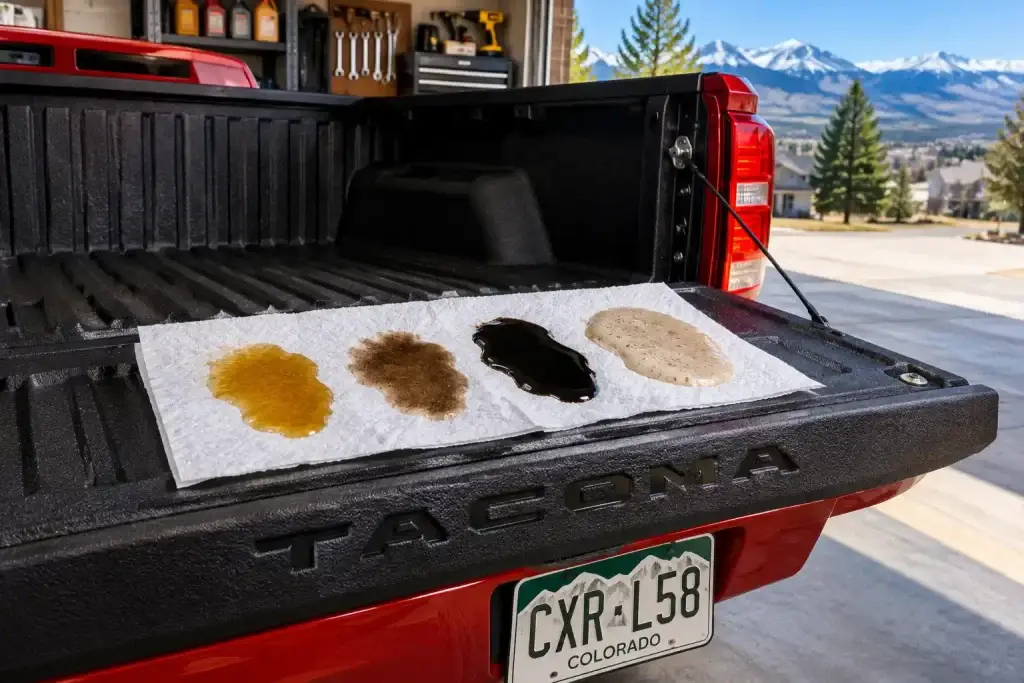
| What you see | What it likely means | What to do |
|---|---|---|
| Clear amber or honey color | Fresh oil | Nothing |
| Brown to dark brown, smooth | Normal used oil | Stick to your service schedule |
| Black, thick or gritty | Old oil or dirt getting in | Plan an oil change soon |
| Milky, light tan or foamy | Coolant may be mixing with oil, or moisture from many short trips | Have it inspected soon |
| Tiny shiny metal flakes | Possible internal wear | See a mechanic before driving much |
| Strong smell of gasoline | Fuel getting into the oil | Have it checked |
One caution: color alone does not tell you when to change oil. Modern oils carry cleaning additives that darken them quickly, often long before the oil is worn out. Go by the mileage and time in your maintenance schedule or your car’s oil life reminder.
How to Know Which Oil Your Car Needs
Adding the wrong oil can cost you fuel and protection. Here is how to check what engine oil you need in under a minute.
- Owner’s manual. Look in the maintenance or specifications section. It lists the viscosity grade, such as 0W-20, and the quality standard the oil must meet.
- Oil filler cap. Many engines print the grade right on the cap, like 0W-16 or 5W-30.
- Your dealer’s parts counter. Give them your VIN and they can tell you the exact spec.
What the Numbers on the Bottle Mean
Take 0W-20 as an example. The number before the W shows how easily the oil flows when the engine is cold. A lower number flows faster on a cold start. The number after the dash shows how thick the oil stays once the engine is hot.
Many newer Toyota engines call for thin oils like 0W-20 or 0W-16. Do not swap to a thicker oil because it feels safer. If the manual says 0W-20, buy 0W-20.
Read the Label Before You Buy
Flip the bottle over and look for two symbols from the American Petroleum Institute. The round “donut” shows the oil’s performance level, its viscosity and whether it is Resource Conserving. The “starburst” means the oil meets the current ILSAC standard for engine protection and fuel economy. Your manual will say which one to look for.
It also pays at the pump. According to FuelEconomy.gov, using the manufacturer’s recommended grade can improve gas mileage by 1% to 2%. Putting 10W-30 in an engine built for 5W-30 can lower it by the same amount.
How to Check Oil Level When Your Car Has No Dipstick
Some newer cars from several brands skip the dipstick. Instead, a sensor measures the oil and shows the level on your dashboard screen.
The steps differ by car, but most work like this:
- Park on level ground with the engine warm.
- Turn the engine off, or leave it running, as your manual says.
- Open the vehicle settings or service menu on the instrument cluster or center screen.
- Select the oil level check and wait for the reading.
If you cannot find the menu, search your owner’s manual for “oil level.” Never guess and add oil without a reading, because overfilling is easy when you cannot see a dipstick.
Checking Oil in a Hybrid
Hybrids have a twist. The gas engine can be off while the car is still on, and it can start by itself without warning. Before you reach under the hood, make sure the whole car is shut off and the READY light is out.
Toyota’s hybrid manuals say to check with the hybrid system at operating temperature and then turned off. After that, the steps are the same as any other car. If you drive one of Toyota’s electrified pickups, our Toyota hybrid truck guide compares how those trucks and their hybrid systems differ.
How Often Should You Check Your Oil?
A good habit is to check your oil level at least once a month. Also check before every long road trip.
Check more often in these cases:
- Your engine has high miles or you have had to top up before
- You see oil spots where you park
- You tow or haul heavy loads, which works the engine harder. If you pull a trailer, see our guide to Tacoma towing capacity for safe limits
- You just had an oil change. Check within a day or two to confirm the level is right and nothing is leaking
Warning Signs Your Oil Is Low
Your car often tells you before real damage happens. Watch for these signs:
- Red oil can light on the dash. This means low oil pressure. Pull over safely and turn the engine off. Do not keep driving. Not sure what a light means? Here is what each dashboard light means.
- Ticking or knocking from the engine. Parts are not getting enough oil.
- Burning oil smell. Oil may be leaking onto hot exhaust parts.
- Blue or gray exhaust smoke. The engine may be burning oil.
- Fresh spots under the car. Brown or black drips point to a leak.
Ignoring these signs can end with a seized engine and a car that will not move. At that point, you are looking at a big repair bill plus how much it costs to tow a car to the shop. A monthly two-minute check is far cheaper.
Frequently Asked Questions
Can I check my oil right after driving?
Yes, but wait at least 5 minutes after you turn the engine off. Toyota’s manuals say more than 5 minutes. Checking sooner gives a low reading because oil is still draining down.
How do I check my oil level if my car has no dipstick?
Use the oil level menu on your dashboard or center screen. Park on level ground, follow the steps in your owner’s manual and wait for the sensor reading before you add any oil.
How do I check engine oil level accurately every time?
Use the same routine every time. Park on the same level spot, wait the same amount of time and make sure the dipstick is fully seated before you read it.
Is it safe to drive if the oil is between the marks but near the bottom?
Yes. Anywhere between the low and full marks is within the safe range. Top up soon so you have a margin before your next oil change.
Can I mix different brands of oil?
Yes, as long as the grade and certification match. Toyota’s manuals ask you to top up with oil of the same type already in the engine. Mixing 0W-20 with 5W-30 is not a good idea.
What happens if I put too much oil in my car?
A little over the full mark is usually harmless. A lot can turn the oil to foam, cause leaks and damage the engine. Have the extra drained if the level is well above full.
Why does my car keep needing oil between changes?
Some engines use a small amount of oil as they run. Regular top ups can also point to a leak or worn parts. If you add oil often, have a mechanic look at it.
Make It a Two-Minute Habit
Now you know how to check oil level in car engines the right way. Park level, wait a few minutes, wipe, dip and read. Then glance at the color and top up only as much as you need.
Do it once a month and before every long trip. Keep a quart of the right oil in your trunk. It is the cheapest insurance your engine will ever get.