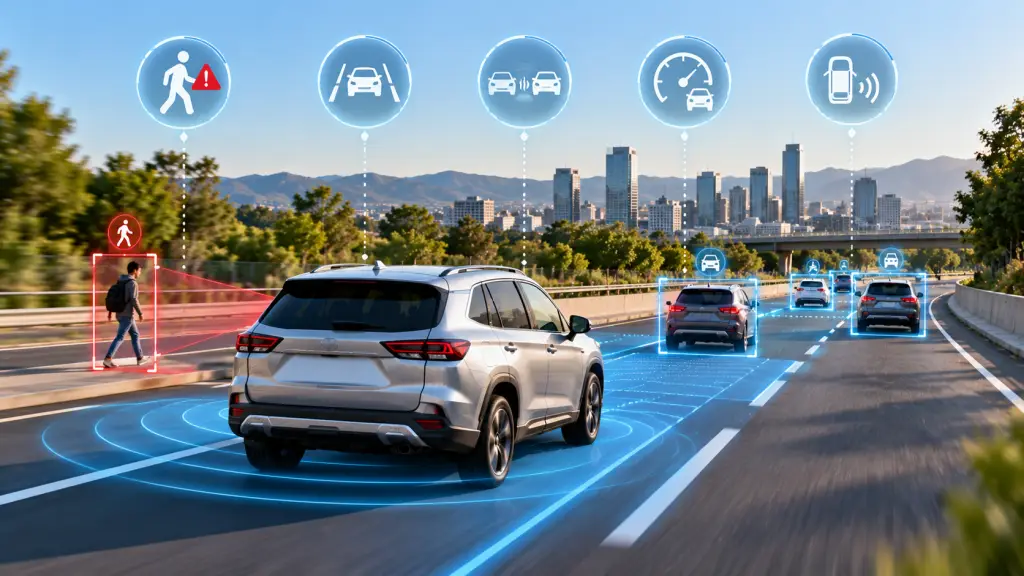
Modern vehicles can include a range of technologies designed to help drivers recognise potential hazards and respond to changing road conditions. Toyota Safety Sense (TSS) is a collection of driver-assistance and active-safety features available on selected Toyota vehicles.
Depending on the vehicle, model year, trim level, and market, the system may include technologies that help detect potential frontal collisions, warn drivers about lane departures, adjust high-beam lighting, maintain a following distance, or display recognised road signs.
These features are designed to assist the driver, not replace attentive driving. Understanding what each system does, when it operates, and where its limitations lie can help owners make better use of the technology.
What Is Toyota Safety Sense?
Toyota Safety Sense is Toyota’s name for a suite of active-safety and driver-assistance technologies. The specific features included vary across TSS versions and individual vehicles.
Systems may use a forward-facing camera, radar, or a combination of sensors to monitor the road. Depending on the feature, they can provide visual or audible warnings, adjust vehicle operation, or apply braking assistance in certain circumstances.
Toyota has introduced different generations of Toyota Safety Sense over time. Consequently, buyers should not assume that every Toyota model has the same features or capabilities. Always check the owner’s manual for the exact vehicle and model year.
1. Pre-Collision System (PCS)
The Pre-Collision System is designed to help detect certain potential frontal collisions. Depending on the system version, it may recognise vehicles, pedestrians, cyclists, or other road users under specified conditions.
If the system identifies a potential collision, it may issue a warning to alert the driver. Depending on the vehicle and circumstances, it may also provide braking assistance or automatically apply the brakes to help avoid a collision or reduce the impact.
What drivers should know
- Detection capabilities vary by system generation and vehicle.
- Performance may be affected by weather, lighting, road conditions, sensor obstruction, and the behaviour of other road users.
- The system cannot guarantee that every collision will be prevented.
- Drivers must continue to observe the road and brake or steer when necessary.
If a vehicle’s warning light indicates a problem with the system, consult the owner’s manual and arrange an inspection when required.
2. Lane Departure Alert (LDA)
Lane Departure Alert uses a camera-based system on equipped vehicles to help identify lane markings and detect certain unintended lane departures. If the system determines that the vehicle may be drifting out of its lane without the appropriate indication, it can warn the driver.
Some vehicles offer additional lane-related assistance, but the available functions depend on the specific Toyota Safety Sense version. Lane Departure Alert should not automatically be assumed to provide continuous steering assistance.
When is it useful?
The feature can provide an additional warning on roads with clearly visible lane markings. However, faded lines, road construction, sharp curves, poor visibility, and adverse weather may affect its operation.
Drivers should remain attentive, check their surroundings, and maintain control of the steering wheel. The system is not a substitute for proper lane positioning or safe driving practices.
3. Automatic High Beams (AHB)
Automatic High Beams can help manage headlight settings when driving at night. On equipped vehicles, a camera or other system inputs detect lighting conditions and certain vehicles ahead, allowing the system to switch between high and low beams under suitable conditions.
This can reduce the need for drivers to change the headlight setting manually while helping provide appropriate illumination.
Important limitations
The system may not respond as expected in every situation. Street lighting, curves, hills, weather, reflective surfaces, and unusual vehicle lighting can affect detection.
Drivers should always be prepared to operate the headlights manually when needed. Automatic High Beams do not remove the driver’s responsibility to avoid causing glare for other road users.
4. Dynamic Radar Cruise Control (DRCC)
Dynamic Radar Cruise Control is designed to help maintain a selected speed and, where supported, a following distance from a vehicle ahead. Depending on the version, the system uses radar and camera information to adjust speed as traffic conditions change.
For example, if a detected vehicle ahead slows down, the system may reduce the Toyota’s speed to maintain the selected gap. When traffic clears, the system may accelerate towards the selected cruising speed within its operating limits.
Some versions support a wider range of speed conditions than others, so drivers should check the manual for their specific vehicle.
Using cruise control responsibly
- Remain attentive to traffic and road conditions.
- Be ready to brake when another vehicle enters the gap or traffic changes unexpectedly.
- Do not assume the system can detect every stationary vehicle, obstacle, or hazard.
- Avoid using the system where road, weather, or traffic conditions make it inappropriate.
Dynamic Radar Cruise Control is a driver-assistance feature. It does not make a vehicle autonomous, and the driver remains responsible for safe operation.
5. Road Sign Assist (RSA)
Road Sign Assist uses a camera-based system on equipped vehicles to recognise certain road signs. Depending on the model and system version, recognised information may be displayed on the instrument panel or another vehicle display.
This can help drivers notice selected signs, including speed-limit information, when the system is able to recognise them.
What to remember
Road Sign Assist may not recognise every sign or interpret every temporary restriction correctly. Sign visibility, weather, road layout, and regional differences can affect its performance.
Drivers must follow the signs and road regulations that apply to their location, even if the displayed information differs from what they see on the road.
Which Toyota Models Have Toyota Safety Sense?
Toyota Safety Sense availability depends on the model, model year, trim, and country. Some vehicles include a particular version as standard equipment, while equipment and functionality may differ in other configurations.
When researching a used Toyota, check the following:
- Confirm the model year. Feature availability can change when a vehicle receives a new generation or safety-system update.
- Identify the exact trim. Vehicles of the same model year may have different equipment.
- Check the market specification. A Toyota sold in the United States may not have exactly the same equipment as a similarly named model sold elsewhere.
- Read the owner’s manual. Confirm the included features, warning indicators, operating conditions, and limitations.
- Inspect the vehicle. Check for sensor damage, windshield replacement, collision repairs, or warning lights that may affect driver-assistance systems.
For accurate model-specific information, consult Toyota’s official website for your market and the documentation supplied with the vehicle. Do not rely on a general model list to confirm the equipment of a particular car.
Toyota Safety Sense and Responsible Driving
Driver-assistance technologies can provide an additional layer of support, but they work within defined operating conditions. Drivers still need to maintain a safe following distance, observe speed limits, check mirrors and blind spots, and pay attention to pedestrians and other road users.
Owners should also follow the maintenance guidance in their vehicle’s manual. Depending on the vehicle, work involving the windshield, camera, radar, or front-end components may require inspection or recalibration of relevant systems.
Understanding these limitations helps drivers use the technology appropriately rather than relying on it to make every driving decision.
Conclusion
Toyota Safety Sense brings together driver-assistance technologies intended to help drivers identify potential hazards and manage selected driving tasks. Features such as the Pre-Collision System, Lane Departure Alert, Automatic High Beams, Dynamic Radar Cruise Control, and Road Sign Assist can provide useful support on appropriately equipped vehicles.
However, feature availability and performance vary by vehicle and system version. Before buying a Toyota or relying on a particular safety function, confirm the equipment for the exact model year and read the relevant owner’s manual.
Toyota Safety Sense works best as an additional aid to attentive, responsible driving—not as a replacement for the driver.
For further reading, explore our article about Toyota’s environmental outreach initiatives.
ToyotaOutreach is an independent automotive information publication. It is not affiliated with or endorsed by Toyota Motor Corpor