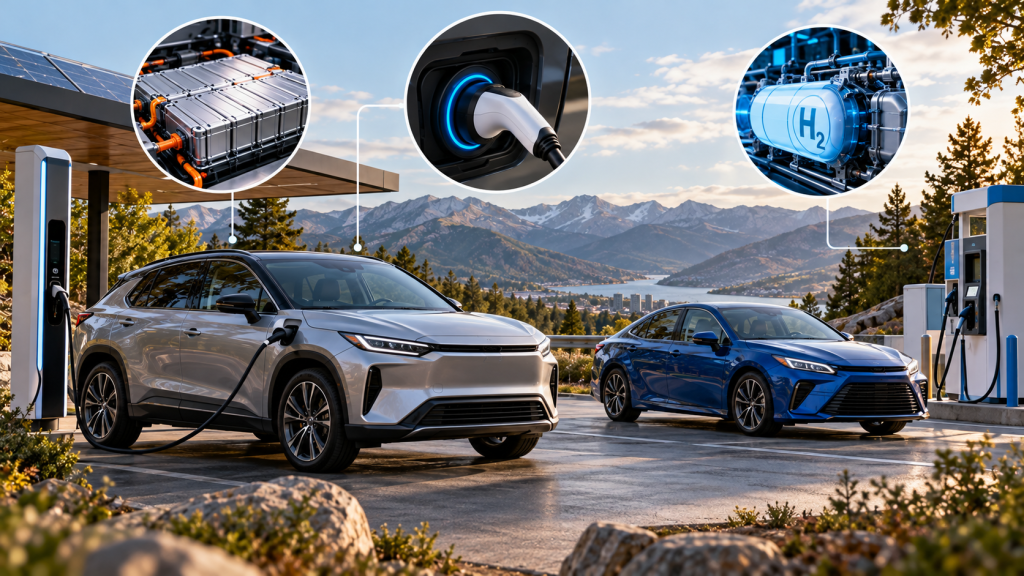
The automotive industry is exploring several ways to reduce the environmental impact of transportation. Battery electric vehicles, plug-in hybrids and hydrogen fuel-cell vehicles each use different technologies to reduce or eliminate tailpipe emissions. Toyota has invested in multiple electrification pathways rather than relying on a single type of powertrain.
For drivers, understanding these differences is important. An electric vehicle may suit someone with reliable home charging, while a plug-in hybrid can provide electric driving with a gasoline engine available for longer journeys. Hydrogen fuel-cell vehicles offer another approach, although their practicality depends heavily on refueling infrastructure.
This guide explains how Toyota’s electric and hydrogen technologies work, what selected vehicles offer, the potential role of next-generation batteries, and the factors drivers should consider before choosing an electrified vehicle.
Toyota’s Multi-Pathway Electrification Strategy
Toyota’s electrification strategy includes several powertrain types designed for different markets, driving patterns and infrastructure conditions. These technologies should not be treated as interchangeable because their charging, refueling and maintenance requirements differ.
The main categories are:
- Hybrid electric vehicles (HEVs): Combine a gasoline engine with an electric motor and battery. Conventional hybrids normally recharge their battery through the vehicle’s powertrain and regenerative braking rather than an external charging cable.
- Plug-in hybrid electric vehicles (PHEVs): Combine an electric powertrain with a gasoline engine and a larger battery that can be charged externally. They can provide electric-only driving for a limited distance, depending on the model and battery charge.
- Battery electric vehicles (BEVs): Use electricity stored in a rechargeable battery to power an electric motor. They produce no tailpipe emissions while driving but require access to charging.
- Fuel-cell electric vehicles (FCEVs): Use hydrogen in a fuel cell to generate electricity for an electric motor. Their practicality depends on the availability of hydrogen refueling stations.
Toyota’s model range varies by country and model year. Buyers should consult official local specifications rather than assume that every vehicle or powertrain is available in every market.
Battery Electric Vehicles: Driving on Stored Electricity
A battery electric vehicle stores electricity in a high-voltage battery and uses an electric motor to drive the wheels. Instead of filling a gasoline tank, the owner recharges the battery using compatible home or public charging equipment.
Toyota’s bZ4X is one example of the company’s battery-electric SUV development. Toyota has also continued to evolve its broader battery-electric vehicle lineup. Exact model names, equipment, driving range and charging capabilities depend on the market and model year.
Potential Benefits of Battery Electric Vehicles
No tailpipe emissions: A BEV does not produce exhaust emissions while driving. However, its total environmental impact depends partly on electricity generation, battery production, vehicle manufacturing and the vehicle’s full lifecycle.
Home and public charging: Drivers with suitable home charging can recharge while the vehicle is parked. Public charging may be necessary for longer trips or when home charging is unavailable.
Electric driving response: Electric motors deliver power directly, providing smooth acceleration and a different driving experience from many conventional gasoline vehicles.
Reduced reliance on gasoline: BEVs do not need gasoline for propulsion. Their running costs depend on electricity prices, charging efficiency, driving habits and maintenance needs.
What to Consider Before Buying an EV
Charging access is one of the most important practical considerations. Drivers should assess whether they can charge at home or work, where public chargers are located along regular routes, and how long charging is likely to take.
Driving range varies with temperature, speed, terrain, tire condition, vehicle load and use of heating or air conditioning. Published range figures should therefore be treated as estimates rather than guaranteed real-world distances.
Before choosing a vehicle, check its official range rating, charging connector, maximum charging capability and warranty terms for the relevant market.
Hydrogen Fuel-Cell Vehicles: How They Work
A hydrogen fuel-cell electric vehicle uses hydrogen stored in onboard tanks. Inside the fuel-cell system, hydrogen reacts electrochemically with oxygen from the air to generate electricity. That electricity powers the vehicle’s electric motor, while water is produced as a reaction byproduct.
Toyota’s Mirai is a well-known example of a hydrogen fuel-cell passenger vehicle. It demonstrates how hydrogen can be used to generate electricity onboard rather than storing all propulsion energy in a large rechargeable battery.
Potential Advantages of Hydrogen Vehicles
Electric-motor driving: Fuel-cell vehicles use electric motors, so their driving characteristics can resemble those of other electric vehicles.
Hydrogen refueling: Refueling can be relatively quick when a compatible hydrogen station is available and operating. Actual refueling conditions depend on the vehicle and station.
No tailpipe carbon dioxide from hydrogen propulsion: A fuel-cell vehicle’s operation produces water as a reaction byproduct rather than gasoline-engine exhaust. This does not mean the complete hydrogen supply chain is emissions-free.
Hydrogen’s environmental benefits depend on how it is produced, compressed, transported and supplied. Hydrogen made using fossil fuels can have a substantial upstream carbon footprint, while lower-emission production methods depend on energy sources and production processes.
The Challenge of Hydrogen Infrastructure
Hydrogen vehicles require specialized refueling stations. Availability remains a major consideration for everyday drivers, and a station network that works for one region may not exist in another.
Before considering a Mirai or another fuel-cell vehicle, buyers should confirm that hydrogen stations operate near home, work and regular travel routes. They should also check station availability, fuel prices, vehicle availability and service support.
Toyota has explored fuel-cell technology beyond passenger cars, including commercial and heavy-duty applications. The suitability of hydrogen for trucks, buses and industrial uses depends on factors such as vehicle duty cycles, payload, infrastructure, energy costs and the availability of hydrogen.
Plug-in Hybrids: Combining Electric Driving and Gasoline
Plug-in hybrid electric vehicles sit between conventional hybrids and fully electric vehicles. They have a rechargeable battery, an electric motor and a gasoline engine.
Toyota has offered plug-in hybrid models such as the Prius Prime and RAV4 Prime in selected markets and model years. Naming and availability can vary by country.
A plug-in hybrid can be charged from an external power source and may complete shorter journeys using electricity alone when the battery has sufficient charge. For longer journeys, the gasoline engine provides additional flexibility.
Who Might Benefit from a Plug-in Hybrid?
A plug-in hybrid may suit drivers who:
- Can charge at home or work regularly.
- Make many short daily trips.
- Want to use electricity for some journeys while retaining gasoline capability for longer trips.
- Prefer not to rely entirely on public charging infrastructure.
However, the benefits depend on charging habits. A plug-in hybrid that is rarely charged may use more gasoline than an owner expects. Compare the vehicle’s electric range, fuel economy, charging time and purchase cost before deciding.
Toyota’s Battery Technology Development
Battery technology affects an electric vehicle’s driving range, weight, charging time, cost, durability and performance. Toyota continues to develop battery technologies intended to address different vehicle and customer requirements.
Lithium-Ion Batteries
Lithium-ion batteries are widely used in modern electric vehicles. Their performance depends on battery chemistry, cell design, thermal management, vehicle efficiency and charging controls.
Battery capacity alone does not determine real-world range. Vehicle weight, aerodynamics, tire resistance, weather and driving speed also influence energy consumption.
Solid-State Batteries
Solid-state batteries replace the liquid electrolyte used in conventional lithium-ion designs with a solid electrolyte. Researchers and manufacturers are investigating this technology because it may offer potential advantages in energy density, charging performance and packaging.
Toyota has publicly discussed development and commercialization plans for all-solid-state batteries for battery electric vehicles, including a target timeline of 2027–2028 in its published plans. This is a development target, not a guarantee that a particular production vehicle will be available by that date or that every projected benefit will be achieved.
Manufacturing scale, cost, durability, supply chains and real-world performance remain important considerations. Drivers should rely on confirmed production specifications and independent testing when evaluating vehicles that eventually use this technology.
Environmental Impact: Tailpipe Emissions Versus Lifecycle Emissions
Electrified vehicles can reduce or eliminate tailpipe emissions, depending on the powertrain. However, comparing their overall environmental impact requires more than looking at the exhaust system.
Important factors include:
- Energy production: Electricity generation and hydrogen production can have different emissions profiles depending on their energy sources.
- Vehicle manufacturing: Producing vehicles and batteries requires energy and raw materials.
- Vehicle use: Annual mileage, driving efficiency and energy consumption affect lifetime emissions.
- Battery and vehicle end of life: Reuse, recycling and responsible material recovery can influence the total environmental footprint.
- Local conditions: The electricity mix, fuel prices, available infrastructure and driving patterns differ between regions.
For this reason, it is more accurate to describe a vehicle as having no tailpipe emissions when that is true, rather than claiming that every electric or hydrogen vehicle is completely emission-free across its entire lifecycle.
Toyota’s broader environmental plans and progress should be assessed using its latest published sustainability reporting. Older announcements and future targets should be clearly dated and distinguished from achievements already confirmed.
How to Choose Between an EV, Plug-in Hybrid and Hydrogen Vehicle
The right powertrain depends on how and where a vehicle will be used.
Choose a Battery Electric Vehicle If…
You have dependable access to charging, your daily driving fits the vehicle’s practical range, and you are comfortable planning longer journeys around charging stops when necessary.
Consider a Plug-in Hybrid If…
You can charge regularly, want electric driving for shorter trips, and still value the flexibility of a gasoline engine for longer journeys.
Consider a Hydrogen Fuel-Cell Vehicle If…
Hydrogen refueling is genuinely available along your regular routes, the vehicle is sold and supported in your market, and the costs and infrastructure suit your needs.
Compare the Total Cost of Ownership
Do not compare vehicles on purchase price or advertised range alone. Consider insurance, energy costs, maintenance, charging or refueling access, warranty coverage, resale value and your expected annual mileage.
Also verify the exact model year and local specifications. A vehicle sold under the same name in two markets may have different equipment, powertrain options or published ratings.
Conclusion: Several Routes Toward Electrified Mobility
Toyota’s electrification work covers conventional hybrids, plug-in hybrids, battery electric vehicles and hydrogen fuel-cell vehicles. Each technology offers different advantages and faces different practical challenges.
Battery electric vehicles can be a good fit for drivers with convenient charging. Plug-in hybrids can combine short electric journeys with gasoline flexibility. Hydrogen fuel-cell vehicles offer electric-motor propulsion with hydrogen refueling, but station availability and hydrogen production are key considerations.
Battery development may improve future vehicle performance, but proposed technologies and commercialization dates should be treated as targets until production vehicles and their specifications are confirmed.
The most useful choice is the one that fits a driver’s location, budget, daily journeys and available infrastructure—not simply the technology with the boldest promise.
ToyotaOutreach.com is an independent publication and is not affiliated with or endorsed by Toyota Motor Corporation. Vehicle specifications, model availability, charging capabilities, fuel-cell infrastructure and warranty terms vary by market and model year.